
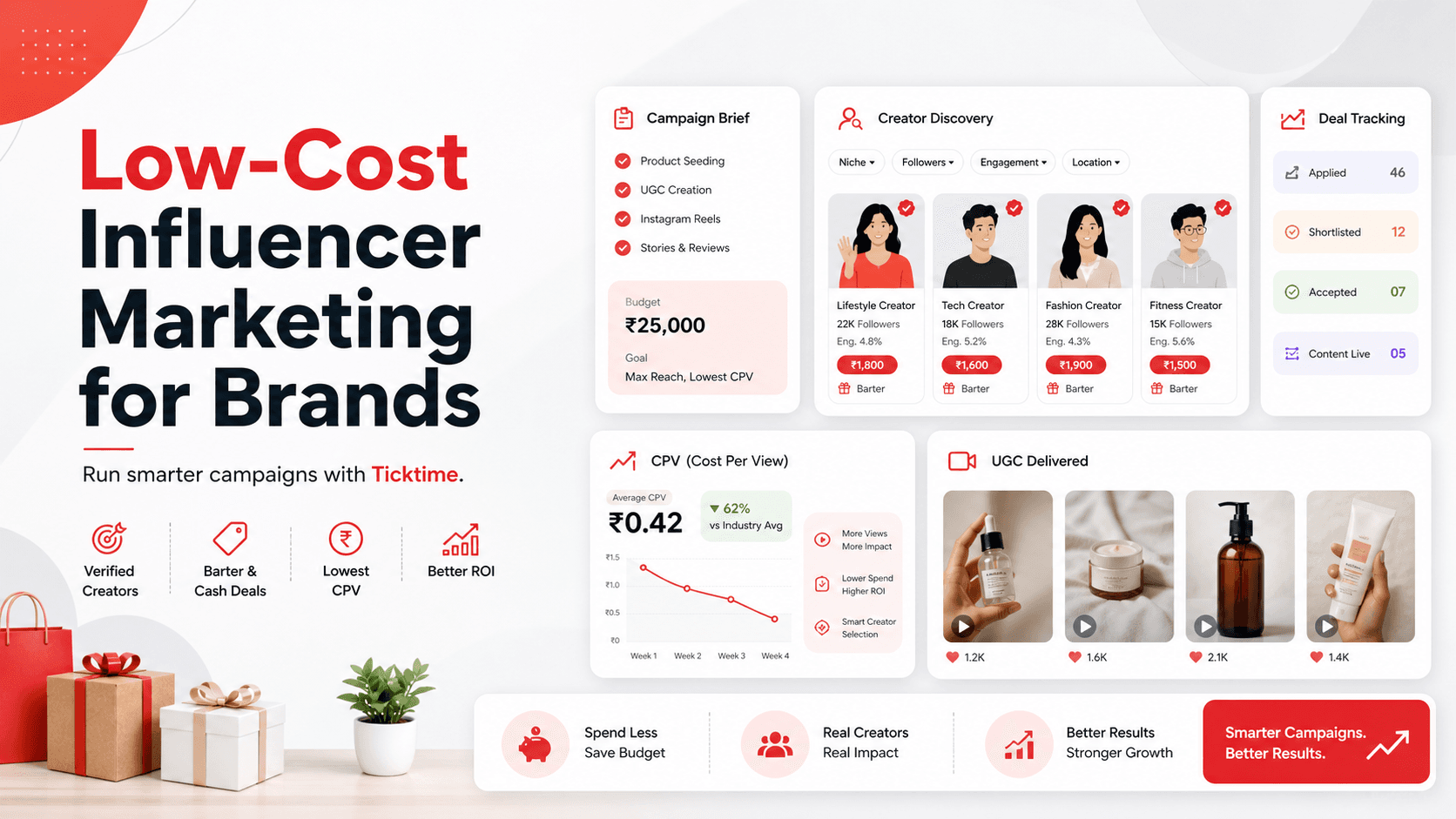
Influencer marketing can get expensive fast if a brand starts by chasing large creators, celebrity posts, or paid campaigns without testing. But for D2C brands, Shopify stores, startups, and growing consumer brands, the smartest path is usually different: start small, test creators, track real performance, and scale only what works.
This is where Ticktime helps brands run influencer marketing campaigns at the lowest practical cost. Instead of managing creators through scattered Instagram DMs and spreadsheets, Ticktime gives brands a structured platform to create campaigns, discover creators, invite influencers, manage barter and paid deals, review content, track progress, and calculate CPV.
If you are searching for barter collaboration brands, influencer gifting platform, barter collaboration with influencers, micro influencer platform, or low-cost influencer marketing for brands, this guide explains how to use Ticktime to reduce waste and get more creator content from your campaign budget.
The low-cost influencer marketing rule: do not start with expensive creators
The biggest mistake brands make is spending most of their budget on one large creator before proving which audience, content style, platform, or product angle works.
A smarter approach is:
- Start with barter and micro creator campaigns.
- Test multiple creators instead of one big post.
- Track CPV, content quality, engagement, and creator reliability.
- Reuse approved creator content as UGC where allowed.
- Move only the best creators into paid or cash + barter campaigns.
This turns influencer marketing from a guessing game into a repeatable growth system.
What is Ticktime for brands?
Ticktime is an influencer marketing SaaS platform for brands to run creator campaigns from one workflow. Brands can create campaigns, discover influencers, invite and shortlist creators, manage deal stages, communicate with influencers, collect addresses, track product shipment, review content, request revisions, approve submissions, and measure performance.
Ticktime supports different campaign types, including:
- Barter collaboration: product exchange for creator content.
- Paid collaboration: cash payment for creator deliverables.
- Cash + barter: product plus payment.
- Review campaigns: product or seller review workflows.
- Barter + review: product-led campaigns with review requirements.
This means your brand can begin with product gifting and later scale into paid influencer campaigns without changing systems.
Step 1: Choose the cheapest campaign type that can still deliver results
The lowest-cost campaign is not always the cheapest-looking campaign. A low-cost campaign should still attract the right creators and produce usable content.
| Campaign type | Brand cost | Best use case |
|---|---|---|
| Barter collaboration | Product cost + shipping | UGC, awareness, product trials, creator testing |
| Cash + barter | Product + small creator fee | Better creators, stronger deliverables, faster timelines |
| Paid collaboration | Creator fee + product if needed | Launches, strict KPIs, high-quality creator production |
| Review campaign | Depends on product and review flow | Commerce, marketplace proof, product trust |
For most budget-conscious brands, the best first move is a barter or cash + barter campaign with nano and micro creators.
Step 2: Use micro and nano creators instead of one expensive post
Nano and micro influencers are often more efficient for early campaigns because they have smaller but more engaged communities. Instead of paying one large creator, your brand can test 20, 50, or 100 smaller creators and learn what works.
Use Ticktime creator discovery to filter by:
- Platform such as Instagram or YouTube.
- Follower range.
- Engagement rate.
- Average likes, comments, and views.
- Location such as city, state, or country.
- Industry and content categories.
- Collaboration preferences such as barter, cash, or cash + barter.
- Maximum collaboration amount.
- Campaign readiness, barter readiness, and commerce readiness.
- Verified email, phone, social account, and Ticktime profile signals.
This helps you avoid paying only for follower count and instead choose creators who fit your product, budget, and audience.
Step 3: Create a clear campaign brief
A low-cost campaign becomes expensive when the brief is unclear. Confused creators submit weak content, brands request multiple revisions, deadlines slip, and the team spends too much time managing basic details.
In Ticktime, create a campaign brief with:
- Campaign title and objective.
- Product details and product value.
- Required platform: Instagram, YouTube, or other channels.
- Content format: Reel, Story, Short, review, unboxing, or UGC video.
- Content requirements and key talking points.
- Special instructions and brand safety notes.
- Application deadline and campaign live date.
- Target influencer count.
- Audience and creator filters.
- Custom form questions if you need extra creator information.
A clear brief reduces revisions and improves the chance that you get usable content from the first submission.
Step 4: Open the campaign to the right creators
Ticktime lets brands create campaigns and make them discoverable to creators when appropriate. Open campaigns are useful when you want inbound creator interest instead of only manual invitations.
To control quality, use filters and requirements such as:
- Industry match.
- Content categories.
- Platform requirements.
- Location targeting.
- Follower range.
- Collaboration type.
- Creator readiness.
This keeps your campaign accessible while still filtering for creators who are relevant to your brand.
Step 5: Shortlist creators using trust and performance signals
To keep costs low, do not shortlist creators only because they have high followers. Look for creators who are verified, active, relevant, and likely to deliver.
On Ticktime, useful signals include:
- Full Ticktime verification.
- Email and phone verification.
- Verified social account ownership.
- Platform verification where available.
- Engagement rate.
- Average video views.
- Recent posting activity.
- Recent platform login and responsiveness.
- Profile completeness.
- Ratings from completed collaborations.
- Past collaboration count.
These signals help you choose creators who reduce campaign risk. Low-cost marketing is not about choosing the cheapest creator. It is about choosing the creator who gives the best chance of useful output for the cost.
Step 6: Use deal tracking so products do not disappear into DMs
Manual barter campaigns often fail because the brand loses track of who accepted, who shared an address, who received the product, and who submitted content.
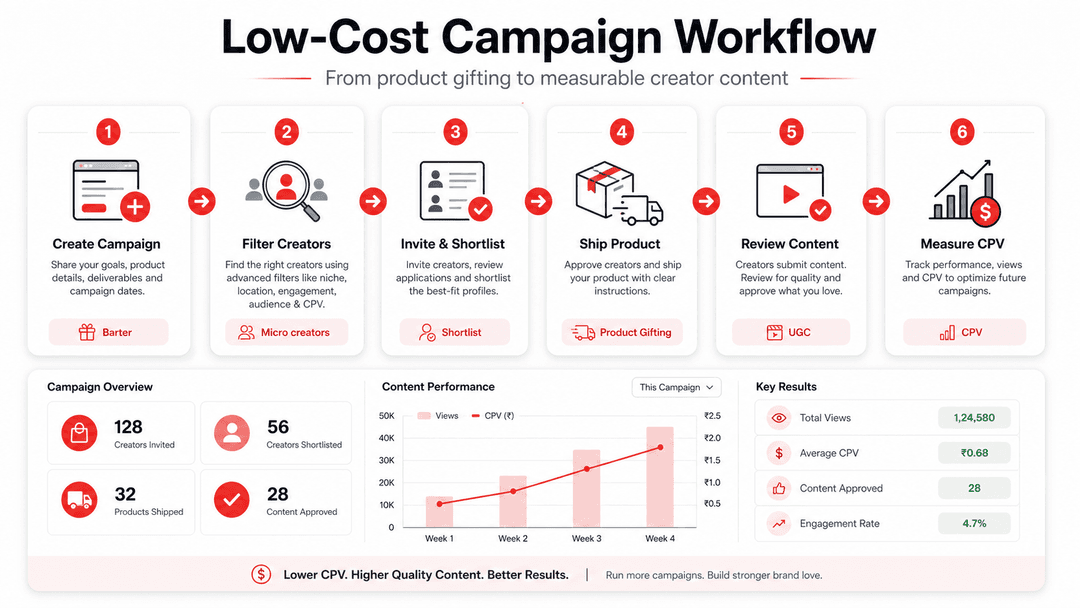
Ticktime gives each collaboration a deal workflow. For barter campaigns, the flow can include:
- Invited
- Accepted
- Shortlisted
- Address requested
- Address provided
- Product shipped
- Product delivered
- Active
- Content submitted
- Under review
- Revision requested
- Approved
- Completed
This reduces leakage. Your team can see who needs a nudge, where product shipping stands, and which creators are ready for content review.
Step 7: Communicate through structured campaign workflows
Low-cost campaigns still need good communication. Ticktime supports creator communication through campaign workflows, including email and WhatsApp-based updates where configured.
Use communication for:
- Campaign invitations.
- Shortlist updates.
- Address requests.
- Shipping updates.
- Content request reminders.
- Revision requests.
- Completion updates.
The faster you move creators through the workflow, the lower your operational cost per completed asset.
Step 8: Review content before counting the campaign as successful
A campaign is not successful just because a creator posted. It is successful when the content matches your brief, reaches the right audience, and can be used for your marketing goal.
Use Ticktime's content submission and review workflow to track:
- Who submitted content.
- Which content is under review.
- Which creators need revisions.
- Which submissions are approved.
- Which deals are completed.
- Which creators should be invited again.
This helps your brand build a creator database over time instead of starting from zero every campaign.
Step 9: Calculate CPV before you scale
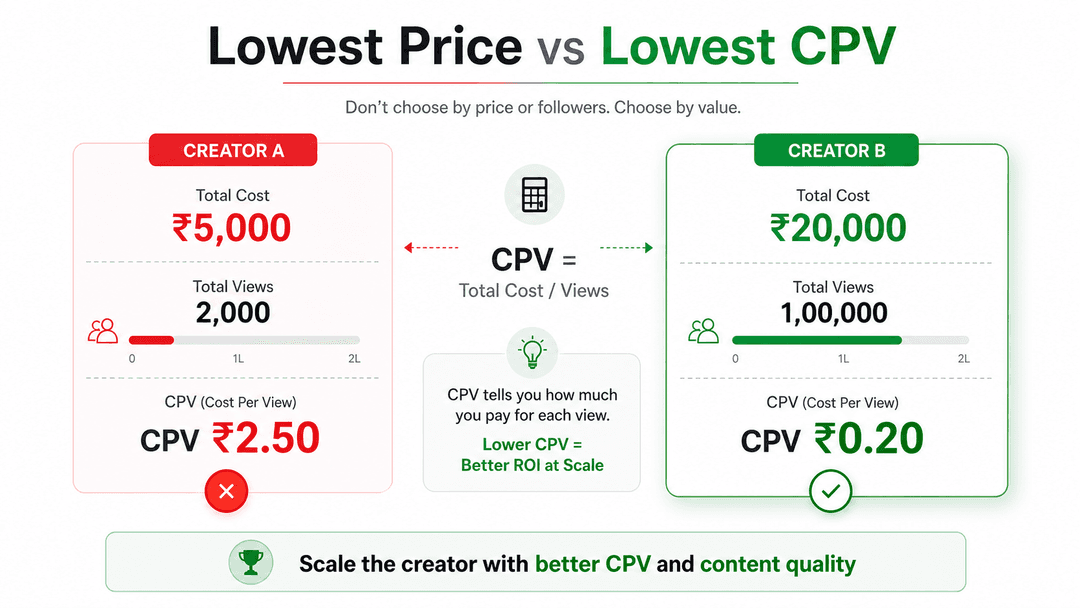
The cheapest creator is not always the most efficient creator. A creator who charges Rs 5,000 and gets 2,000 views has a CPV of Rs 2.50. A creator who charges Rs 20,000 and gets 1,00,000 views has a CPV of Rs 0.20.
The CPV formula is:
CPV = Total campaign cost / Total viewsFor barter campaigns, include product cost and shipping:
Barter CPV = Product cost + shipping cost + operational cost / Total viewsUse Ticktime's CPV calculator to compare creators and avoid paying for follower count alone. CPV helps you decide which creators are worth repeating and which campaign formats should be scaled.
Step 10: Turn approved creator content into reusable UGC
One way to reduce marketing cost is to get more value from each approved content piece. If usage expectations are agreed with the creator, approved content can support:
- Brand social posts.
- Landing pages.
- Product pages.
- Shopify UGC galleries.
- Retargeting creatives.
- Ad testing.
- Founder or sales decks.
Ticktime's Shopify and UGC tooling can help brands connect creator content with commerce experiences, especially when approved creator assets are useful as product proof.
Sample low-cost campaign plan for a D2C brand
Here is a practical example for a brand with a limited budget.
| Campaign element | Recommended setup |
|---|---|
| Goal | Generate UGC and test product-market fit across creators |
| Campaign type | Barter or cash + barter |
| Creator tier | Nano and micro creators |
| Target creators | 25-50 creators |
| Deliverables | 1 Reel or Short + 2-3 Stories per creator |
| Filters | Industry, category, platform, city, engagement, readiness, verification |
| Measurement | CPV, content approval rate, engagement, completed deals, reusable UGC |
| Scale rule | Move top creators into paid or cash + barter campaigns |
This approach gives the brand multiple content angles, more creator learnings, and lower risk than spending the full budget on one macro influencer.
How Ticktime keeps influencer marketing cost low
Ticktime helps reduce cost in five ways:
- Better creator fit: Search and filters help brands find creators by niche, platform, location, readiness, and budget.
- Lower cash outlay: Barter and cash + barter campaigns let brands start with product value instead of large creator fees.
- Less manual work: Deal workflows reduce the cost of managing creators one by one in DMs.
- Better measurement: CPV helps brands compare creators by efficiency instead of follower count.
- Reusable content: Approved creator content can become UGC for product pages, social proof, and ads when rights are aligned.
FAQ: low-cost influencer marketing with Ticktime
What is the cheapest way for brands to start influencer marketing?
The cheapest practical way is to start with barter collaborations or cash + barter campaigns with nano and micro creators. Track CPV and content quality before scaling into paid campaigns.
Can brands run barter collaborations on Ticktime?
Yes. Ticktime supports barter campaigns where brands provide products or services in exchange for creator content. It also supports paid, cash + barter, review, and barter + review workflows.
Why should brands use micro influencers?
Micro influencers often have stronger engagement and niche trust than larger creators. They are useful for product testing, UGC generation, and low-cost awareness campaigns.
How does Ticktime help brands avoid fake or weak creators?
Ticktime helps brands review creator signals such as verification, engagement, follower range, social account data, ratings, recent activity, and completed collaboration history.
What is CPV in influencer marketing?
CPV means cost per view. It is calculated as total campaign cost divided by total views. Brands should use CPV to compare creator efficiency before scaling campaigns.
Can brands use Ticktime for paid influencer campaigns too?
Yes. Brands can run paid campaigns, barter campaigns, cash + barter campaigns, and review campaigns depending on budget, deliverables, and creator fit.
How can a brand reduce campaign management time?
Use Ticktime's structured deal workflow for invitations, shortlisting, address collection, shipment tracking, content submission, revisions, approvals, and completion.
Final takeaway: low-cost does not mean low-quality
The goal is not to spend the least possible amount on creators. The goal is to spend the least amount required to get useful reach, strong content, and reliable campaign learning.
Ticktime helps brands do that by combining barter collaboration, creator discovery, campaign workflows, content review, communication, CPV measurement, and UGC use cases in one platform.
If your brand wants to run influencer marketing without wasting budget, start with a focused barter or micro creator campaign on Ticktime, measure CPV, and scale only the creators who prove their value.