
Getting brand collaborations should not depend only on random Instagram DMs, cold emails, or hoping a brand manager finds your profile. If you are a nano influencer, micro influencer, UGC creator, YouTuber, Instagram creator, or campus creator, you need a system that helps brands discover you, trust you, and invite you to the right campaigns.
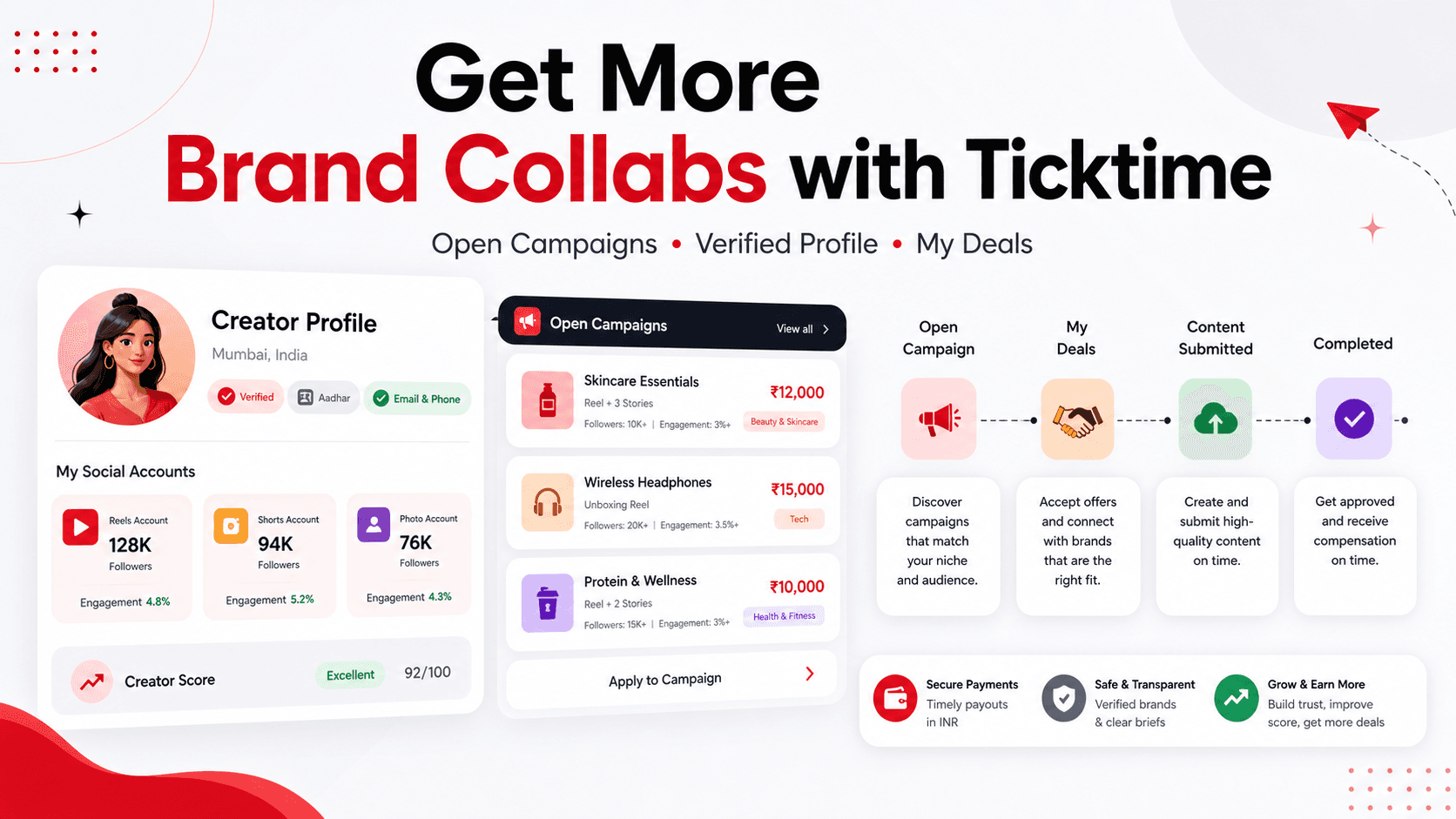
That is where Ticktime helps. Ticktime is a creator and influencer collaboration platform where creators can set up a professional profile, verify their identity, connect social accounts, discover open campaigns, apply for barter and paid collaborations, manage deals, submit content, and build a track record with brands.
If you are searching for a barter collab platform, barter collaboration app, influencer gifting platform, brand deals for influencers, or campaigns for influencers, this guide explains how Ticktime works for creators and what you should complete to get maximum benefit from it.
What is Ticktime for creators?
Ticktime is a platform for creators to find and manage brand collaborations. It supports different types of influencer campaigns, including barter collaborations, paid collaborations, cash + barter campaigns, product review campaigns, and creator-led brand campaigns.
Instead of managing everything in DMs, Ticktime gives creators a structured workflow:
- Create a creator account.
- Complete your profile.
- Verify email, phone, and Aadhaar details.
- Add and verify social accounts like Instagram and YouTube.
- Set campaign readiness and collaboration preferences.
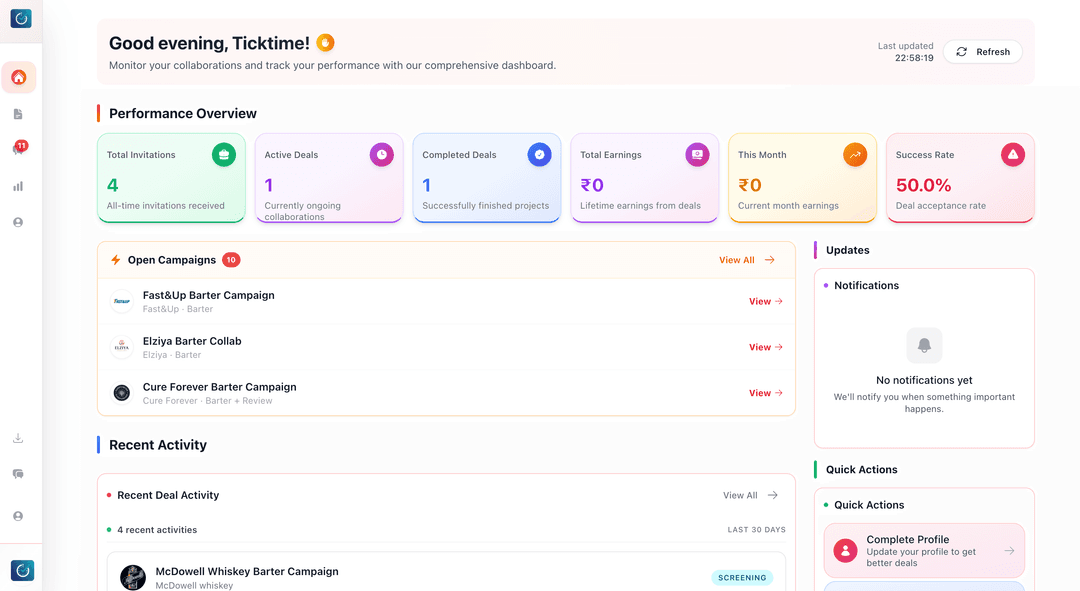
- Browse open campaigns.
- Accept or apply for campaigns that fit your niche.
- Track every deal in My Deals.
- Submit addresses, content, revisions, and campaign updates in one place.
- Build ratings and completed collaboration history over time.
For creators, the biggest benefit is simple: brands can understand your profile faster, and you can manage collaborations more professionally.
What types of collabs can creators find on Ticktime?
Ticktime is useful whether you are looking for barter collabs, paid campaigns, or hybrid brand deals.
| Collab type | What it means | Best for |
|---|---|---|
| Barter collaboration | Brand sends a product or service; creator makes content | Nano creators, micro creators, portfolio building, product gifting |
| Paid collaboration | Brand pays cash for agreed deliverables | Creators with strong content, engagement, and campaign history |
| Cash + barter | Creator receives both product and payment | Higher-effort content, better-performing creators, premium products |
| Review campaign | Creator reviews a product or seller through a required flow | Commerce creators, product reviewers, YouTube and marketplace content |
This is why Ticktime can be understood as both a barter collab platform and a broader influencer barter collaboration platform for creators who want to grow into paid brand work.
How to sign up on Ticktime as a creator
To get started, create your creator account from the Ticktime official website or Ticktime app flow. Use the creator or influencer signup option, then add your basic account details.
Your first goal is not just to create a login. Your first goal is to create a profile that gives brands enough confidence to shortlist you.
After signup, complete these steps:
- Add your name, creator username, and profile image.
- Add your email and phone number.
- Verify your email.
- Verify your phone number.
- Fill your bio with your content niche and audience promise.
- Select your industry and content categories.
- Add your location details such as city, state, and country.
- Add your social media accounts.
- Set collaboration preferences and campaign readiness.
- Upload Aadhaar details for profile verification where required.
Why profile completion matters
Brands search creators using filters. If your profile is incomplete, you may not appear in the right searches, even if your content is good.
Ticktime stores creator details such as bio, industry, categories, location, gender, age range, collaboration preferences, minimum collaboration amount, response time, campaign readiness, and social metrics. These help brands decide whether you are a fit for a campaign.
To improve your chances, complete:
- Bio: Explain your niche, audience, and content style clearly.
- Industry: Choose the main category that best represents your content.
- Content categories: Add all relevant categories so brands can discover you by niche.
- Location: Add city, state, and country because many campaigns target specific regions.
- Age range and gender: Add accurate details when comfortable, because brands may filter by campaign fit.
- Profile image: Use a clean image that makes your profile feel real and brand-safe.
- Address details: Keep shipping information ready for barter campaigns where brands send products.
Why email, phone, and Aadhaar verification help you get collabs
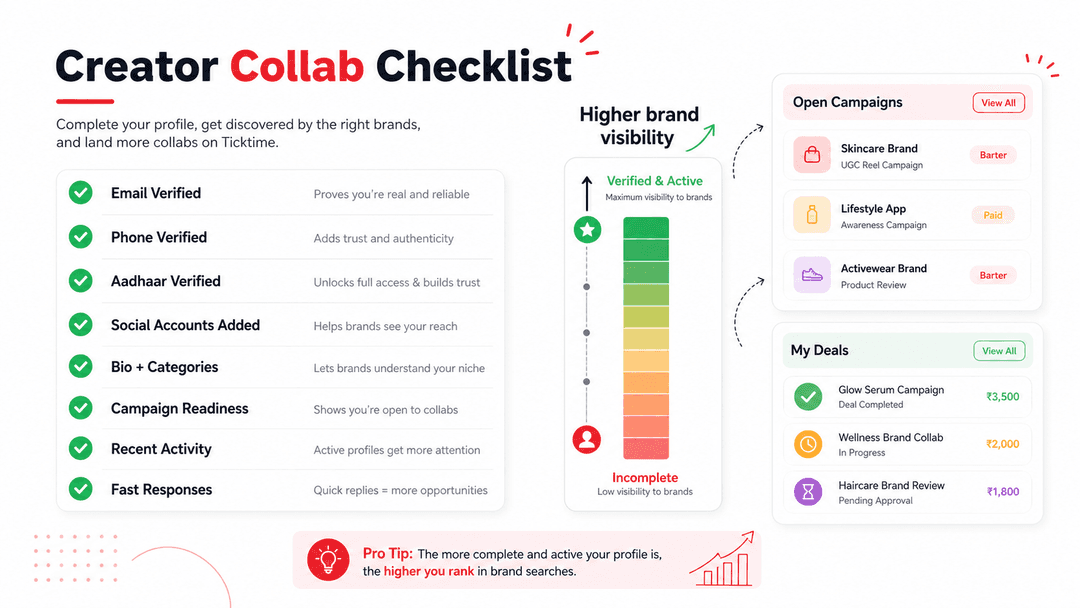
Brands want to work with creators who are real, reachable, and reliable. Ticktime uses verification signals to help brands identify trustworthy creators.
On Ticktime, stronger verification can include:
- Email verification: Shows that your email is active and reachable.
- Phone verification: Shows that your contact number is valid for campaign communication.
- Aadhaar document and number: Helps Ticktime verify your profile identity where required.
- Full profile verification: A creator profile becomes fully verified when Aadhaar details, email verification, and phone verification are complete.
This matters because Ticktime's brand-side creator ranking gives strong priority to fully verified creator profiles, followed by email and phone verification. In simple terms: a verified creator looks safer and more professional to brands.
Verification does not guarantee a brand deal, but it can improve trust and visibility compared with an incomplete or unverified profile.
How to add social accounts the right way
Your social accounts are the proof behind your creator profile. Add your Instagram, YouTube, TikTok, Facebook, LinkedIn, or other relevant platforms depending on where you create content.
For each social account, make sure you add:
- Correct platform.
- Correct handle without spelling mistakes.
- Valid profile URL.
- Accurate follower count.
- Engagement rate when available.
- Average likes, comments, video views, and post count when available.
- Profile bio and display name where supported.
Ticktime can also identify platform verification and Ticktime-owned social account verification signals. If your account is verified on the platform or verified by Ticktime as belonging to you, that can help brands trust your profile more.
Another important detail: recent activity matters. If your linked social account has recent posts, brands can see that you are active and ready for campaigns. A creator who has not posted in months may look risky to a brand with a live campaign deadline.
Set your campaign readiness
Ticktime lets creators show whether they are ready for different types of campaigns. This is one of the most important setup steps.
Update these settings carefully:
- Campaign ready: Use this when you are ready for general brand campaigns.
- Barter ready: Use this when you are open to product or service exchange campaigns.
- Commerce ready: Use this when you are ready for shopping, review, or commerce-led campaigns.
- Collaboration types: Choose cash, barter, or cash + barter based on what you actually accept.
- Minimum collaboration amount: Add a realistic minimum for paid collaborations.
- Response time: Select how quickly you usually reply.
- Current availability: Mark yourself available, busy, or unavailable.
- Faster response priority: Use this if you can respond quickly to urgent campaign opportunities.
Brands can filter creators by campaign readiness, barter readiness, commerce readiness, collaboration preferences, budget, and faster responses. If these fields are empty or inaccurate, you may miss campaigns that are a good fit.
How open campaigns work on Ticktime
Open campaigns are campaigns that eligible creators can discover and join or apply for from Ticktime. These campaigns may be barter, paid, cash + barter, or review-based.
The flow is simple:
- Go to your creator dashboard.
- Open the Deals section.
- Switch to the Open Campaigns tab.
- Review the brand, title, description, deal type, platform, deadline, product value, and campaign requirements.
- Check whether the campaign fits your niche, audience, location, and content style.
- Accept or apply when the campaign is relevant.
- Once accepted, the campaign moves into My Deals.
Some open campaigns may require an industry match. If a brand wants creators only from specific industries, your profile industry must match the campaign requirement. This is another reason to keep your industry and categories accurate.
How My Deals works after you join a campaign
After you accept or get invited to a campaign, the collaboration moves into My Deals. This is where you track every step of the collaboration.
For barter campaigns, your deal can move through stages such as:
- Invited
- Accepted
- Screening
- Profile in Review
- Shortlisted
- Address requested
- Address provided
- Product shipped
- Product delivered
- Active
- Content submitted
- Under review
- Revision requested
- Approved
- Completed
For paid campaigns, product shipping may not be needed. For review campaigns, the flow may involve order placement and order delivery instead. The important thing is that Ticktime keeps the campaign status visible so you know what to do next.
How brands search for creators on Ticktime
To get maximum benefit from Ticktime, you need to understand how brands find creators. Brands can search and filter influencers using multiple signals, including:
- Name, username, bio, industry, social handle, content keywords, and bio keywords.
- Platform, such as Instagram or YouTube.
- Follower range.
- Engagement rate.
- Average likes, average comments, and average video views.
- Location: country, state, or city.
- Gender and age range.
- Industry and content categories.
- Collaboration preferences such as cash, barter, and cash + barter.
- Minimum collaboration amount compared with brand budget.
- Campaign readiness, barter readiness, and commerce readiness.
- Faster response availability.
- Instagram or YouTube account presence.
- Platform verification and Ticktime account verification.
- Hashtags and mentions from your content captions.
- Audience location, audience gender, interests, languages, and age range where available.
This means your profile should be accurate and searchable. Do not write a vague bio like "creator | dreamer | collabs DM." Instead, write a useful creator bio that includes your niche, content format, audience, and city when relevant.
What helps creators rank higher in brand searches?
Ticktime's recommendation system is designed to surface creators who are trustworthy, relevant, active, and campaign-ready. The strongest signals include verification, ratings, engagement, platform proof, profile completeness, activity, and collaboration history.
Here is the creator-friendly version of what matters:
| Visibility factor | Why it matters | What you should do |
|---|---|---|
| Full Ticktime verification | Brands trust verified creators more | Complete Aadhaar, email, and phone verification |
| Email and phone verification | Shows you are reachable | Verify both as soon as you sign up |
| Ratings from collaborations | Good completed work builds trust | Deliver on time and maintain brand relationships |
| Platform verification | Shows stronger social proof | Link the right social accounts and keep them accurate |
| Engagement rate | Brands care about audience response | Create content that gets comments, saves, shares, and views |
| Follower count | Still matters, but less than trust and fit | Grow organically and avoid fake followers |
| Recent activity | Brands prefer active creators | Post consistently and keep social accounts updated |
| Recent login | Shows you are likely to respond | Check Ticktime regularly |
| Profile completeness | Helps brands understand fit quickly | Fill bio, industry, categories, location, and preferences |
| Collaboration experience | Completed deals prove reliability | Start with relevant campaigns and complete them well |
The takeaway: the best way to rank higher is not to fake numbers. It is to build a complete, verified, active, and reliable creator profile.
How to write a Ticktime profile that brands can find
Your bio and category choices help brands discover you. Use words that match how brands search.
For example, instead of:
Lifestyle creator. DM for collab.Write something more useful:
Bangalore-based beauty and skincare creator making Reels, product reviews, unboxings, and routine videos for Indian D2C brands. Open to barter, cash + barter, and paid campaigns.This gives brands useful search signals: city, niche, format, product category, content style, and collaboration preference.
How to choose the right campaigns
Do not apply to every campaign just because it is open. Brands want creators who fit the product.
Before accepting a campaign, ask:
- Does this product fit my niche?
- Would my audience care about it?
- Can I create the required format: Reel, Story, YouTube Short, review, or UGC?
- Can I meet the deadline?
- Is the product value or payment fair for the effort?
- Do I understand the content requirements?
- Can I communicate clearly if a revision is needed?
A creator who accepts fewer but better-fit campaigns can build a stronger profile than a creator who accepts everything and submits weak content.
How to turn barter collabs into paid campaigns
Many creators start with barter collaborations. That is normal. Barter campaigns help you build proof, learn brand workflows, and create examples of product-led content.
To move from barter to paid:
- Complete every barter campaign professionally.
- Submit content on time.
- Follow the brief without losing your creator style.
- Ask for feedback after completion.
- Keep your best collaboration examples ready.
- Track average views and engagement on sponsored content.
- Set a realistic minimum collaboration amount once you have proof.
- Choose cash + barter campaigns when product value alone is not enough.
Brands pay creators who reduce risk. Your profile, verification, delivery history, ratings, and content quality all reduce risk for the brand.
Common mistakes creators should avoid on Ticktime
Mistake 1: Leaving profile sections blank
An incomplete profile is harder to match with campaigns. Fill your bio, industry, categories, location, social accounts, and collaboration preferences.
Mistake 2: Not verifying email, phone, and Aadhaar
Verification is one of the strongest trust signals. If you skip it, you may look less reliable than verified creators.
Mistake 3: Adding wrong social handles
Brands need accurate profile links. A wrong handle or broken URL can cost you a shortlist.
Mistake 4: Saying yes to every campaign
Bad-fit campaigns can hurt your content quality and brand rating. Choose campaigns that match your audience.
Mistake 5: Delaying replies
Campaigns move fast. Recent login and fast response signals matter. Check Ticktime often and respond quickly.
Mistake 6: Missing content deadlines
Late content can reduce your chance of repeat campaigns. If you need more time, communicate early.
Mistake 7: Buying fake followers
Fake followers can hurt engagement and trust. Ticktime and brands care about engagement, real activity, verification, and delivery, not only follower count.
Ticktime creator checklist before applying to campaigns
Use this checklist before applying to open campaigns:
- Email verified.
- Phone verified.
- Aadhaar details uploaded where required.
- Profile verification completed or in progress.
- Profile image added.
- Bio clearly explains niche and content style.
- Industry selected correctly.
- Content categories selected.
- City, state, and country updated.
- Instagram, YouTube, or relevant social accounts added.
- Social handles and URLs checked.
- Campaign ready, barter ready, or commerce ready settings updated.
- Collaboration preferences selected.
- Minimum collaboration amount added for paid work.
- Response time and availability updated.
- Recent content posted on your social accounts.
FAQ: using Ticktime to get brand collabs
Is Ticktime a barter collab platform?
Yes. Ticktime supports barter collaborations where creators receive products or services in exchange for content. It also supports paid, cash + barter, and review campaign workflows.
Can nano influencers use Ticktime?
Yes. Nano and micro influencers can use Ticktime to discover open campaigns, build a collaboration history, and grow from barter campaigns into paid brand work.
How do I get brand deals on Ticktime?
Sign up as a creator, complete your profile, verify email and phone, upload Aadhaar details where required, add social accounts, set campaign readiness, and apply to relevant open campaigns.
Does verification help me get more collabs?
Verification can improve trust and visibility. Ticktime's creator recommendation logic gives strong priority to fully verified profiles and email/phone verification.
Why should I add my location?
Many brands search by city, state, or country. Location also matters for shipping products in barter campaigns and for region-specific campaigns.
Why should I set collaboration preferences?
Brands can filter by creators open to cash, barter, or cash + barter campaigns. If your preferences are missing, you may not appear in the right campaign searches.
How can I rank higher in brand searches?
Complete your profile, verify email and phone, finish Aadhaar verification, add accurate social accounts, stay active, post recently, improve engagement, respond quickly, and complete campaigns professionally.
Can I use Ticktime for paid campaigns?
Yes. Ticktime supports paid campaigns as well as barter and cash + barter collaborations. Set your collaboration preferences and minimum collaboration amount so brands understand what you accept.
Final takeaway: Ticktime works best when your profile is complete, verified, and active
Ticktime can help creators discover open campaigns, apply for brand deals, manage collaborations, and build a professional creator profile. But the platform works best when you give brands enough information to trust you.
If you want maximum benefit from Ticktime, focus on the basics: complete your profile, verify email and phone, finish Aadhaar verification, add accurate social accounts, set campaign readiness, choose relevant campaigns, respond quickly, and deliver quality content on time.
That is how creators move from random DMs to repeat brand collaborations.